Blog
How do you get peptides into cells?

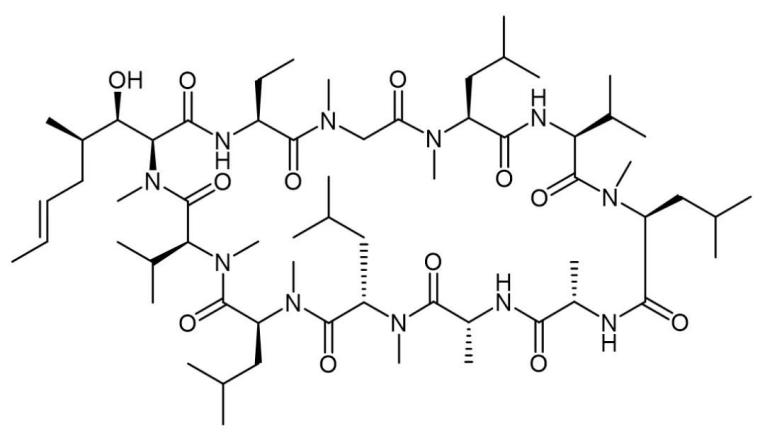
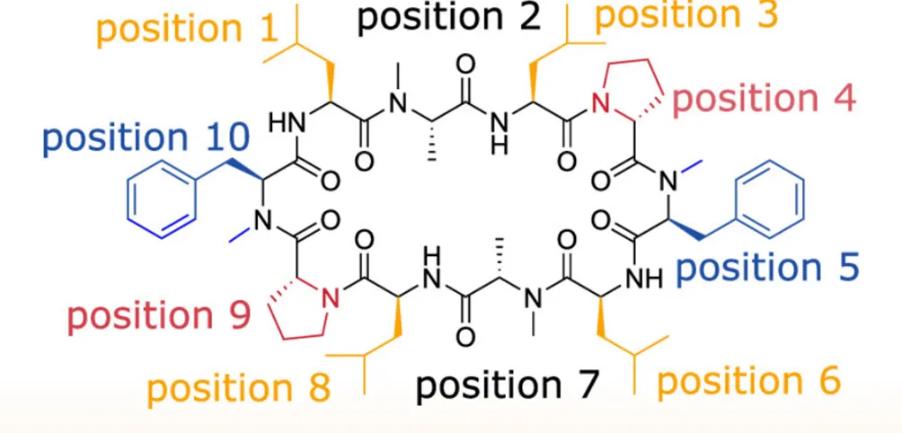
However, the oral delivery of Cyclosporine A has stimulated people’s enthusiasm for the development of oral peptides, but the key to completely opening the door to oral peptides has not been fully presented, and people are still searching for the realization of oral bioavailability of peptides. In addition to the stability of peptides and their resistance to degradation by a variety of enzymes, how to cross the cell membrane is also one of the focuses of research. Researchers from the University of ETH in Switzerland recently simulated the molecular dynamics of peptide crossing the cell membrane using a flexible decacyclic peptide (Fig.2).
In contrast to straight-chain peptides, which are too flexible, cyclic peptides have what are known as chameleon properties. Chameleons change skin color based on the environment, while cyclic peptides can change the molecular conformation based on the polarity of the environment. This property depends on the conversion of intramolecular and intermolecular hydrogen bonds in the cyclic peptide molecule.
In the so-called Open conformation of investigational peptide drugs, the hydrogen-bonded atoms of cyclic peptides are exposed to a polar environment (e.g., in blood or cytoplasm) to form hydrogen bonds with their counterparts in solvents, or with polar solvent molecules. But when the environment becomes non-polar (e.g., inside a cell membrane), cyclic peptides can instead adopt the so-called Closed conformation, wrapping themselves up and encapsulating themselves by forming intramolecular hydrogen bonds, encapsulating polar groups inside the molecule and exposing the non-polar structure to surface of the molecule, thereby reducing the polar area and the desolvation energy (the amount of energy required for the solute to be removed from the water or other solvents). This chameleon property of cyclic peptide is helpful in the development of oral peptide formulations because it can balance good water and fat solubility, which favors increasing cell permeability.
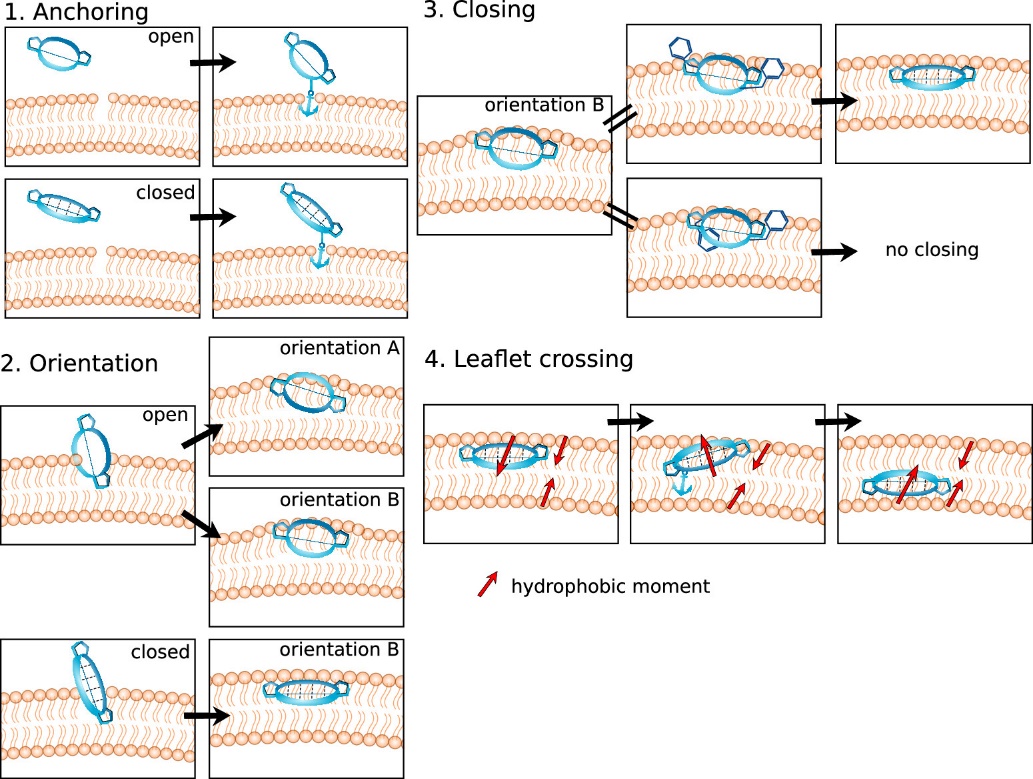
The Closed state is generally considered to be the predominant permeability state of cyclic peptides. However, it is a dynamic process that is controlled by a variety of factors such as sequence, molecular size, hydrophobic surface area, etc. Through molecular dynamics simulation, the researchers simulated the process of cyclic peptide molecules crossing the cell membrane through passive osmosis into the cell, highlighting the importance of flexible conformation for cyclic peptide membrane permeation, and dividing it into four steps (Fig.3):
- Specific peptide side-chain residues can act as molecular anchors to establish the initial contact of cyclic peptides with the cell membrane before the peptide molecule is inserted into the cell membrane.
- After anchoring to the cell membrane, the peptide molecule jumps directly into it, inserting itself into the interface between the polar head and non-polar tail regions of the cell membrane. In this process, the cyclic peptide exhibits two potential directions of arrangement, and the open state takes orientation A and B, and preference orientation A is preferred. Closed cyclic peptides take orientation B only.
- The Open state transitions to the Closed state, increasing the chance of it penetrating. At this time, the chameleon nature of the peptide molecules is very important for them to move from a polar environment to a non-polar environment. It is difficult for the cyclic peptide in the open state to achieve the subsequent diffusion process.
- Only cyclic peptide molecules in the closed state are likely to diffuse from this polar/non-polar mixed environment on the cell membrane surface through the non-polar lipid membrane leaflet and spread to the polar/non-polar interface on the other side. Through the anchoring and flipping mechanism, the final transmembrane journey is achieved.